.png)
Essay Competition 2027
The essay competition is open to all secondary school students and members of the public. Winning entries will be published in an essay compilation book and distributed to all participating schools.
Last updated on 10 November 2026
About 2027's Concept: Communication
Communication is not always about finding the right words. It can be found in a parent’s gentle reassurance, a quiet moment beside someone we love, or a simple gesture that says what words cannot. Sometimes, a glance or a nod is enough to convey what matters most.
Every day, we communicate in ways both spoken and unspoken. Some messages are easy to share; others are difficult to put into words. Yet, even in silence, we can express what we feel, what we believe in, and what matters to us.
Eligibility Criteria
Essay Competition Categories (School and Open)
School Category1 | Open Category |
|---|---|
Junior Senior 1Including institutions offering Integrated Programme (Years 1 to 4 only) | Anyone age 13 and above* *Students classified under the School Category can choose topics under the Open category and will compete with other Open participants. |
Essay Topics (School Junior (Sec 1 - 2))
Each submitted entry should be focused on one of the two topics below.
Topic 1
Word Limit: 750 words
Imagine you meet a stranger and discover that organ donation has played an unexpected role in their life. Write a story about your encounter and what you discover. Explore how this experience changes the way you see an organ beyond its physical function, and how it shapes you as a person.
Some helpful pointers:
Think about who this stranger might be.
Could they be a donor's family member, a recipient, or someone who was once on the waiting list?
Or maybe a doctor, an uncle at the kopitiam, a taxi driver, a florist or even a content creator who just happens to have played a small an indirect role in the lives of an organ donor and/or recipient through their job.
Focus on the specific moment of your encounter and what you discover about their connection to organ donation.
Reflect on how this encounter shifts your understanding of organs beyond their physical function, and what it means for you personally.
Read stories (opens in new tab) on organ donors and recipients to gain some insights of their journey.
Topic 2
Word Limit: 500 words
Inspired by a lesson on organ donation at school, you read stories about how organ donation has saved and transformed lives. Deeply moved by these stories, you share about what you have learnt with your parents, who suggested for you to write to your grandparents overseas. Your grandparents have lived overseas for many years and may not know much about organ donation.
Write your letter to your grandparents overseas, stating clearly:
The stories you have read and what you learnt from them.
Why organ donation matters to you and your family (your parents and grandparents).
Why you think it is important for your grandparents to consider organ donation.
What steps your grandparents could take regarding organ donation.
Some Key Pointers:
You may include other details that you think will be helpful.
Write you email in clear, accurate English.
Your tone should be respectful and engaging.
You should use your own words as much as possible.
Essay Topics (School Senior (Sec 3 - 5))
Each submitted entry should be focused on one of the two topics below.
Topic 1
Word Limit: 1500 words
“Talking about organ donation is easy until it involves someone you love.” Do you agree? Why or why not?
Some helpful pointers:
Research on the subjects discussed first.
What does it mean to talk about organ donation in general?
How might that change when it involves someone close to you?
Imagine yourself in these 2 scenarios and how you would react differently or indifferently.
Decide on your stance and write down the points you will be discussing.
Do not just state the points supporting your stance. Make sure to explain why.
Topic 2
Word Limit: 1000 words
Your school is organising a youth forum on how young people can champion social issues. You have chosen to speak about organ donation because you believe that young people have a role to play in helping others understand this important issue.
Write a speech to be delivered at the forum. In your speech, you should:
Explain why you chose to speak about organ donation and what sparked your interest in it.
Explain why organ donation is an important issue for young people to understand, even if it may not seem relevant to them at this stage of their lives.
Suggest how young people can raise awareness of organ donation and encourage meaningful conversations about it.
Discuss how greater understanding of organ donation among young people could benefit the wider community and Singapore.
Some helpful pointers:
You may add any other details you think will be helpful.
Write you email in clear, accurate English.
Your tone should be engaging and convincing.
You should use your own words as much as possible.
Essay Topics (Open)
Each submitted entry should be focused on one of the two topics below.
Topic 1
Word Limit: 1500 words
“Silence is not neutrality; it is a decision.” To what extent do individuals have a responsibility to discuss their wishes about organ donation with their loved ones?
Some helpful pointers:
Research on the subjects discussed first.
What does it mean to discuss your wishes about organ donation?
What are the barriers that may lead people to stay silent (if any)?
What does responsibility mean in the context of the subject?
Decide on your stance and write down the points you will be discussing.
Do not just state the points supporting your stance. Make sure to explain why.
Topic 2
Word Limit: 1500 words
“A conversation about organ donation is only meaningful if it leads to immediate action.” Discuss.
Some helpful pointers:
Research on the subjects discussed first.
What does a meaningful conversation about organ donation look like?
What counts as “immediate action”?
What does absence of “immediate action” look like?
Decide on your stance and write down the points you will be discussing.
Do not just state the points supporting your stance. Make sure to explain why.
Judging Criteria
Essays will be evaluated based on the following criteria.
Relevance
How closely your essay matches up to the chosen topic.
Creativity
Your ability to think out of the box; to present unique ideas effectively and to do things nobody else has done before!
Language
How well you are able to use varied words and sentences that are appropriate.
The best essays do not always use up the maximum word count. Be concise!— The Guru
Prizes
All participants will receive a Certificate of Participation. Winners stand to have their essays published in our compilation book and distributed to participating schools. Winners will also receive up to $500 Capitaland Vouchers!

1st Prize
$500 Capitaland Voucher

2nd Prize
$350 Capitaland Voucher

3rd Prize
$200 Capitaland Voucher

A total of 65 prizes will be awarded!
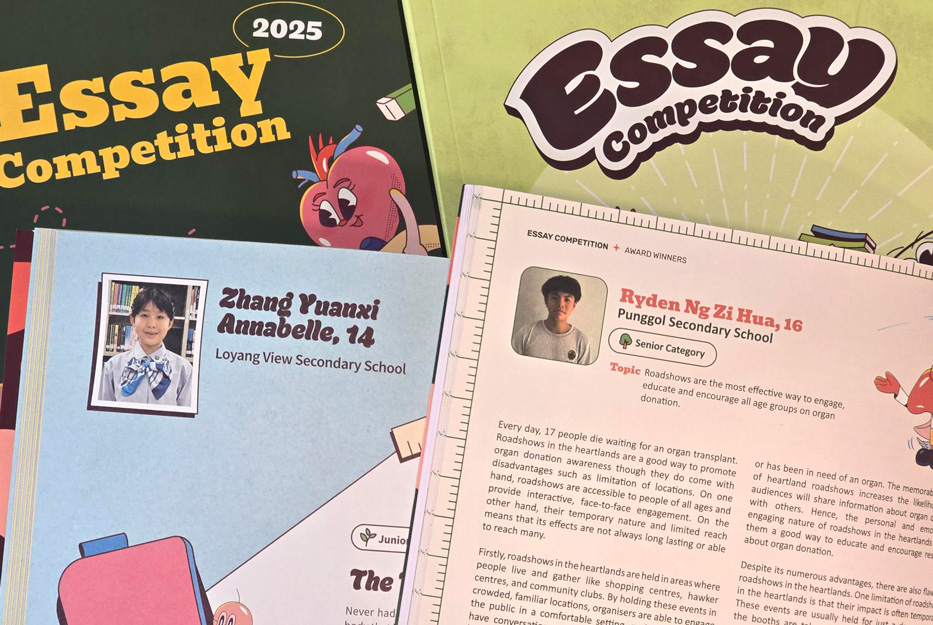
Winning essays published in essay books.
Psst! Here's a tip but don't tell anyone! A creative and unique essay will stand out more among the thousands of entries!— The Chill Buddy
Key Dates for LOF 2027
Key Dates of the Competition are subject to changes.
Date | Activity |
|---|---|
1 January 2027 | Submissions Open |
January to May 2027 | Competition Period and Sharing Sessions |
28 May 2027 | Submissions Close |
End August 2027 | Awards Ceremony and Release of Results |
13 – 24 September 2027 | Distribution of Certificate of Participation |
From October 2027 to June 2028 | Physical exhibitions of selected winning artworks and essays at various locations (e.g. schools, hospitals and libraries). |
Interested in joining LOF or sharing LOF with your students?
Read through the step-by-step guides for more details!
Terms and Conditions
The published terms and conditions below are accurate as of 10 November 2026.
Definitions
The Organiser refers to the National Organ Transplant Unit (NOTU), Ministry of Health, Singapore.
Competition period refers to the period in which the competition is held, i.e. from 1 Jan 2027 0000hrs to 28 May 2027 2359hrs.
Themes refer to the LOF 2027 Design Competition Themes, which are “Communication Beyond Words” and “Our Organs, The Courageous Storytellers”.
Topics refer to the LOF 2027 Essay Competition Topics, as specified in Essay Topics.
Eligible Participants refer to Singapore Residents (Singapore Citizens, Permanent Residents, and residents with valid work permit / employment pass / student pass), who are 13 years old or above in the year of competition (i.e. 2026).
Online Portal refers to the online form for submission of entries.
Eligibility and Submission Procedure
This competition is open to Eligible Participants only. Entries submitted by non-eligible participants will be automatically disqualified. All Eligible Participants are hereon referred to as “Participants”.
Participants will be assigned to categories based on the following criteria:
School Category (Design) –
Students enrolled in MOE mainstream secondary schools (including schools offering Integrated Programme, Year 1 – 4 only) or MOE Special Education schools only.
School Category (Essay) –
Junior: Secondary 1 and 2 students enrolled in MOE mainstream secondary schools (including schools offering Integrated Programme, Year 1 – 2 only) or MOE Special Education schools only.
Senior: Secondary 3 and 5 students enrolled in MOE mainstream secondary schools (including schools offering Integrated Programme, Year 3 – 4 only) or MOE Special Education schools only.
Open Category (Design and Essay) – Participants who are age 13 and above and do not fall into the School category.
Participants are assigned to the School Category by virtue of their enrollment.
For student entries, the teacher-in-charge shall act as a point of contact between the Organiser and the student. They should not be doing any substantial work on behalf of the students, but is allowed to brainstorm with, advise or guide students on the artwork (including artist statement) or essay direction. They should ensure that the artworks and essays are produced by the students themselves and to the best of their ability.
Students may choose to participate in the competition on their own. While a teacher-in-charge is not mandatory for participation, students are encouraged to notify their respective Subject / Co-Curricular Activity and/or Form Teacher of their participation. This is to facilitate communication on matters such as award notifications, and attendance at Awards Ceremony, where necessary.
Participants are required to keep a record of the references and AI prompts used and submit them together with the final artwork or essay.
Participants may submit multiple entries. Each entry requires a new, separate submission. For participants who submitted duplicated entries (i.e. same entry submitted more than once), only the latest submission, as determined by date and time of receipt, will be considered. All earlier duplicate submissions will be disregarded.
Participants shall make full and honest disclosure of particulars as requested, including but not limited to in the application form. Any misrepresentation of particulars may result in disqualification, at the Organiser’s sole discretion.
For individual submissions through the Online Portal, an acknowledgement screen will be shown for all successful FormSG submissions. Participants are encouraged to keep a copy of the auto-generated acknowledgement email from FormSG as proof of submission. Direct submissions through alternative channels (including email) will not be accepted.
For school-based group submission, the teacher-in-charge can arrange for group submission of entries at liveonlivetwice@notu.com.sg. Please contact the Organiser at 6321 3649 or 6326 5878 if you do not receive an acknowledgement within three working days.
The closing date for submissions is 28 May 2027 (Friday), 2359 hours. All entries submitted will be acknowledged accordingly through your respective teacher-in-charge or FormSG auto-generated reply. Late entries will not be accepted. The Organiser is not responsible for entries that are lost, late, incomplete, corrupted, misdirected, or cannot be delivered / entered (due to technical issues or otherwise) into the competition.
Participants are to retain all working files, journal drafts and notes (including references and any AI prompts and outputs) for one year from the closing date of submissions.
By submitting an entry, participants give the Organiser the right to contact you regarding your essay, and the right to mention your name, age, school and/or photograph, for the sole purpose of identifying you as the author of the essay and/or winner of the competition.
Artwork / Essay must be an original creation
Artwork(s) and essay(s) must be created specifically for the Live On Festival and completed during the Competition Period. By submitting an entry, participants declare that they are the creator and rightful owner of all rights (including intellectual property, copyright, etc.), and that it has not been published or submitted for other purposes.
Participants must ensure that there is no plagiarism or violation of copyrighted work. To the extent permitted by Singapore Laws, Regulations and other Government Gazetted documents, participants may reference existing artworks, images or materials solely for inspiration. However, such sources must be appropriately acknowledged in writing as part of the submission. Copying or reproduction of existing works (including minor modifications), or reproducing content from existing works, including paraphrasing with minimal changes, is strictly prohibited and will result in disqualification.
The participant shall be liable and provide compensation in the event of any action, claim or proceedings brought against the Organiser by a third-party as a result of infringement of existing copyright caused by the participant in participation to the competition.
The use of AI-generated content to produce, rewrite, or substantially contribute to any submission is not allowed. This applies to both essays and artworks. The use of generative AI tools is permissible for conceptualisation purposes only (for e.g., to explore themes/topics, generate initial ideas, develop a creative direction) and participants are required to keep a record of the AI prompts and outputs.
The following are strictly prohibited and will result in disqualification:
Use of AI image generation tools to produce the final artwork (including but not limited to tracing of an AI generated artwork, whether in whole or in part)
Use of AI writing tools to draft, write, or substantially rewrite the final essay
Presenting or passing off any AI-generated content as one’s own original creative work
Participants are required to disclose, at the point of submission, any AI tools used during the creation of their entry, including the purpose for which each tool was used. Participants must also submit the AI prompts used during the conceptualisation and ideation process as part of their submission. While participants are not required to submit the AI-generated outputs at the point of submission, they are required to retain these outputs and must be able to produce them upon request by the organisers. This disclosure will not in itself disqualify an entry, provided that the use of AI was limited to conceptualisation as described above.
Participants may be required, upon request by the organisers, to demonstrate their creative process – for e.g. by providing sketches, working files and journal drafts or other process documentation – to verify that the final submission is their own original work. Failure to provide such evidence when requested, or provision of false or misleading evidence, may result in disqualification.
The Organiser reserves the right to screen all submissions, including essays and artworks, for plagiarism and AI-generated content to ensure compliance with originality requirements.
The Organiser may appoint a committee to review any alleged plagiarism or inappropriate AI use. The decision of the committee is final and the organiser is not obliged to share the reasons for decision.
Artwork Requirements
Artwork must be related to one of the Themes, with a focus on organ donation and / or transplantation. The artwork must be suitable for printing on tote bags.
Submissions can be in either traditional or digital media, in either landscape or portrait orientation. Refer to the important submission guidelines for artwork size, resolution and format requirements.
Traditional artworks will be collected and scanned for judging purposes and returned after the Awards Ceremony. Avoid materials that may interfere with scanning on flatbed scanners (e.g. reflective surfaces or three-dimensional objects).
Artwork submitted shall be in good taste and must not contain any element that is deemed indecent, blasphemous, libelous, offensive, pornographic, politically insensitive, or otherwise, unlawful or depict any inappropriate activity. The Organiser reserves the rights to reject any entry that is deemed to be inappropriate.
Artwork submitted must be original work and do not depict any logos, trademarks, copyrighted materials, brand names, imagery or characters owned by third parties.
Entries must not have been published, previously submitted for other competitions or accepted for broadcast through any media (including but not limited to print, web/internet, television, or social media posts which are made private or publicly viewable).
Entries must not be concurrently submitted for other competitions, distributed, broadcasted or otherwise made public, until the results of this competition are officially announced.
Essay Requirements
Essay must be related to one of the Topics, within the relevant category, with a focus on organ donation and / or transplantation. The essay must be written in English.
Essay should be typewritten and submitted in word document. Participants should adhere to the prescribed word count limit for their category. Refer to the important submission guidelines for the format requirements.
Essay submitted must comply with Singapore laws and regulations and adhere to principles of social morality and good order. Essay must not contain any element that is deemed indecent, blasphemous, libelous, offensive, pornographic, politically insensitive, or otherwise, unlawful or depict any inappropriate activity. The Organiser reserves the rights to reject any entry that is deemed to be inappropriate.
Entries must not have been published, previously submitted for other competitions or accepted for broadcast through any media (including but not limited to print, web/internet, television, or social media posts which are made private or publicly viewable).
Entries must not be concurrently submitted for other competitions, distributed, broadcasted or otherwise made public, until the results of this competition are officially announced.
Rights to your artwork / essay
You reserve the rights to your artwork / essay. By entering the competition, you grant the Organiser the right to use your entry, in full or in partiality, to advertise, publicise or otherwise communicate, through various media of its choosing, including, but not limited to, online and offline publications, social media, television, public screenings and any other electronic media, but not limited to the Internet, or other purposes in a manner it deems fit to showcase LOF, organ donation and transplantation, without notification to you.
The Organiser reserves the right to publicise the artworks and essays in this competition on its media channels and/or other public-facing programmes, events or platforms for communications and outreach purposes beyond LOF. Credit will be given to the participant as the creator of the artwork or essay, unless it is impractical to do so (e.g. use in small-format collaterals).
You may choose to revoke the rights to your artwork / essay by writing to the Organiser and by providing at least two months’ notice. Revocation of rights will result in immediate disqualification of the entry. If the revocation occurs after the awarding of entries, qualifications will be cancelled, and the prize must be returned to the Organiser in its original state and packaging. The participant may be liable for any corrective works, monetary or otherwise, which may be incurred as a result.
Grounds for disqualification
Entries submitted with incomplete, inaccurate or invalid application forms may be disqualified. The Organiser reserves the right to determine whether an application form is valid.
The Organiser may request additional documents or proof to verify your eligibility to participate in the competition. Failure to provide such proof within 3 working days will result in immediate disqualification of entry.
Allegations of copyright infringement, plagiarism or predominant use of AI-generated content will be subject to investigation, and any entry found to be in violation will be disqualified.
Participants must adhere to the prescribed word count limit for their respective categories and topics for the essay competition. Entries that exceed the word count limit will be disqualified.
In the event that a selected winner is disqualified from Live On Festival 2027, the prize must be returned to the Organiser. In the case of late discovery of copyright infringement where the winning entry has been published, the participant shall pay the Organiser any damages, monetary or otherwise, which may be incurred as a result.
For winners that were subsequently disqualified, the Organiser, at its sole discretion, may decide whether a replacement winner should be selected. In this event, any further winners will be selected based on the same criteria as set out in the judging criteria and Terms and Conditions. The Organiser can repeat this process any number of times until it has selected a winner in accordance with the Terms and Conditions.
Judging & Awards
Every participant with a valid entry will receive a certificate of participation.
Each participant is entitled to only one prize per competition category. In the event the same participant is associated with more than one winning entry in the same competition category (e.g. Essay Junior category), only the highest-ranked entry will be awarded.
The judges’ decision is final. Appeals will not be entertained. The Organiser will not be held liable to provide a reply to any appeals regarding judging outcome.
Winners from the School Category will be informed by the teacher-in-charge (where applicable). All other winners will be contacted as per the contact details provided in the application. Winners who are uncontactable within this period or fail to respond after three attempts to contact, will have been deemed to have made an incomplete submission and the Organiser reserves the right to select a replacement winner, forfeit the prize or to donate the prize to charity.
A photograph of the winner may be requested for release on the Organiser’s webpage, published collaterals, roadshows and exhibitions nationwide.
Winners are required to attend an awards ceremony, scheduled to be held on one of the Saturdays in August/September 2027 (tentative). Winners are required to nominate a proxy to attend the awards ceremony if they are unable to do so.
Prizes are not transferable or exchangeable for cash. The Organiser accepts no responsibility for any tax or other liability that may arise from the prize winnings. Prizes are subject to availability and the Organiser reserves the right to substitute the prizes with another item of a similar value without prior notice.
All Rights Reserved
The terms and conditions are always at the sole discretion of the Organiser.
The Organiser does not assume any liability for any unlawful or unlawfully produced entry.
The Organiser reserves the right in its sole discretion, to cancel, terminate, modify or suspend the competition.
The Organiser reserves the right in its sole discretion, to amend these terms and conditions of the competition at any time without prior notice.
Submission of entries signifies your acceptance of the terms and conditions listed herein
Have a question or feedback?
Fill in the form below or message us on Instagram!